

Keeping silicon quantum bits accurate while they work together could help turn established chipmaking technology into larger quantum computers capable of tackling increasingly complex problems.
The manufacturing technology behind everyday computer chips could help build larger quantum computers. Silicon spin qubits offer that possibility, but the precision they achieve on their own can slip when several are controlled at once.
Researchers from the RIKEN Center for Emergent Matter Science and their collaborators have now demonstrated a way to preserve much of that precision during simultaneous operation. Working with five silicon qubits controlled through a single shared microwave line, they identified a major source of control errors and developed a calibration protocol to compensate for it. Their study was published in Nature Physics.
Quantum bits, or qubits, represent combinations of the conventional binary states 0 and 1. In silicon spin qubits, information is encoded in the spin of an electron trapped in a silicon substrate. Microwave signals manipulate those spins to carry out quantum operations. A useful quantum computer must perform many such operations simultaneously, making reliable parallel control essential.
High precision with three qubits at once
The team’s optimized device design and carefully calibrated microwave pulses produced single-qubit gate fidelities well above 99.99% on each of the five qubits when tested individually, with the best approaching 99.999%. Fidelity measures how accurately a quantum operation is performed. With the new protocol, fidelities stayed above 99.99% when up to three qubits operated at the same time.
“This shows that high-fidelity control can be maintained even when several qubits are operated at the same time and represents an important step toward scaling up silicon-based quantum processors,” says Leon Camenzind, a RIKEN research scientist and co-first author who supervised the experiments.
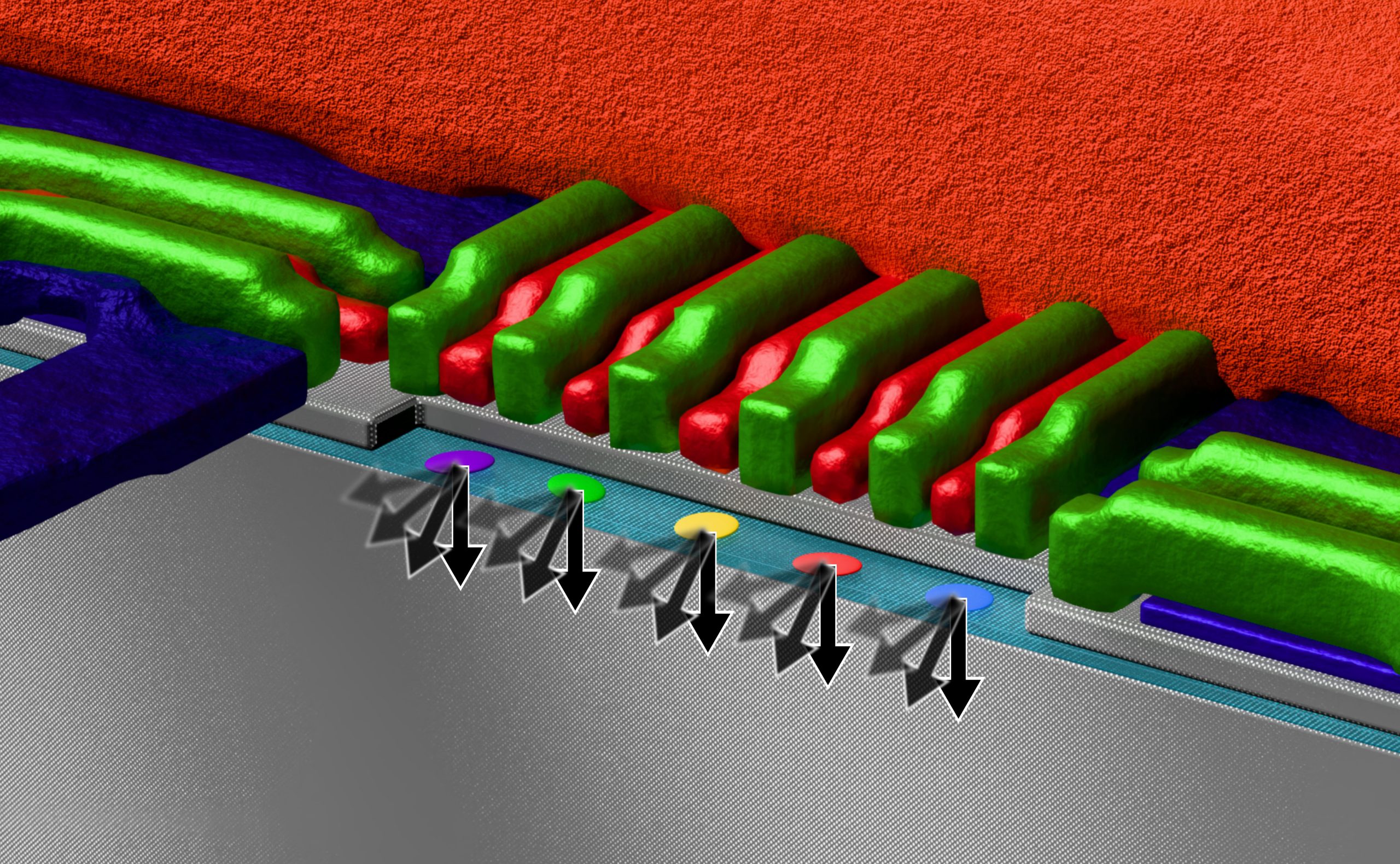
When all five qubits operated simultaneously, fidelities remained at approximately 99.9%, close to the practical requirements of fault-tolerant quantum computing, which is designed to keep computations reliable despite errors.
“Our long-term goal is to build a fault-tolerant quantum computer based on silicon spin qubits, and reliable parallel control is an essential step toward that goal,” says Seigo Tarucha, project manager of a silicon quantum computing project under JST’s Moonshot Goal 6.
Correcting phase shifts, pair by pair
The researchers traced a major source of the accuracy loss during parallel operation to the AC Stark shift, an effect induced by the microwave control signals. It changes a qubit’s effective energy levels and shifts the phase of its quantum state. Phase describes how the wave-like components of that state line up with one another. These unwanted shifts interfere with the control needed to perform the intended operation.
Correcting those shifts required a calibration method that could accommodate more qubits without separately testing every possible combination. Yi-Hsien Wu, the first author, who carried out the experiments as part of his PhD research, explains how the team approached that challenge. “Rather than requiring an entirely separate calibration procedure for every possible combination of qubits, our method uses calibrations between pairs of qubits to compensate for the unwanted phase shifts.”
“By addressing a key source of control errors through pairwise calibration,” says Camenzind, “our study supports the use of shared control lines as a practical approach to scaling up quantum processors. Combined with silicon’s compatibility with established semiconductor manufacturing, we believe that this advance could help pave the way toward larger quantum processors capable of performing increasingly complex computations.”
The remaining loss of accuracy was attributed to drive-induced decoherence caused by the increased microwave power needed for simultaneous operation. This involves a loss of quantum coherence, distinct from the phase shifts addressed by the calibration protocol. “This is a limitation, but further improvements to device design could help mitigate this source of error,” says Camenzind.
Reference: “Simultaneous high-fidelity single-qubit gates in a spin qubit array” by Yi-Hsien Wu, Leon C. Camenzind, Patrick Bütler, Ik Kyeong Jin, Akito Noiri, Kenta Takeda, Takashi Nakajima, Takashi Kobayashi, Giordano Scappucci, Hsi-Sheng Goan and Seigo Tarucha, 15 October 2026, Nature Physics.
DOI: 10.1038/s41567-026-03466-2
Never miss a breakthrough: Join the SciTechDaily newsletter.
Follow us on Google and Google News.
1 Comment
While the research team at the RIKEN Center for Emergent Matter Science, in collaboration with National Taiwan University, ETH Zurich, and TU Delft (Nature Physics, Wu, Camenzind et al.), makes valuable strides in mathematically compensating for AC-Stark shifts using pairwise phase calibrations along a shared microwave line, the underlying bottleneck remains structural: driving spin states with transverse microwave pulses inherently induces drive-induced decoherence and field bleed.
Rather than relying on software calibration to constantly correct the software artifacts of an interfering electromagnetic grid, a physical hardware alternative lies in straight-line directional propagation coupled with localized strain tuning. By routing incoming and outbound information along a uniserial waveguide and modulating individual qubit resonance through piezoelectrically tuned mechanical stress (tension, torque, or compression), physical stress replaces orthogonal field crossings.
Combining the strain-tuning hardware insights from piezoelectric quantum-control groups with the multi-qubit silicon platforms developed across RIKEN, NTU, ETH Zurich, and TU Delft could help eliminate drive-induced decoherence entirely at the hardware layer—offering a clean pathway toward scalable, low-power silicon spin architectures. Reference Link : https://docs.google.com/document/d/1biCbf_Sbtk-AuqrWQnD-w4xOPzrHcRKwA9MHk_6kuyY/edit?usp=drive_link 🖖